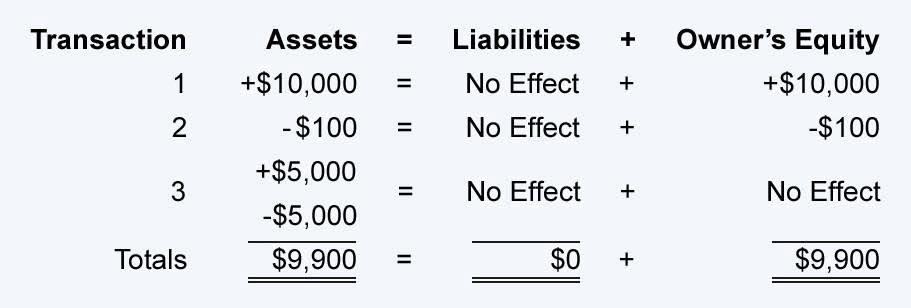
Profits are recorded in a profit and loss account, which is a type of income statement. Expenses are recorded in an expense account, which is a type of cost account. Revenue is recorded in a revenue account, which is accounting for a law firm a type of income account. Revenue, expenses, and profits are three key concepts that are essential to understanding the financial health of any business. This equation states that assets must always equal liabilities plus equity.
Different Types of Accounts
When the good is sold, it records a decrease in inventory and an increase in cash (assets). For example, if a business sells a good, the expenses of the good are recorded when it is purchased, and the revenue is recorded when the good is sold. A bakery purchases a fleet of refrigerated delivery trucks on credit; the total credit purchase was $250,000. If a business buys raw materials by paying cash, it will lead to an increase in inventory (asset) while reducing cash capital (another asset).
Types of accounts used in a double-entry system
You will therefore debit utility expenses and credit cash. If your business pays a utility bill of $3,500, the asset account decreases (cash) while the expense account increases. Understanding these accounts helps you understand the effect of a particular transaction. The importance of double entry system lies in its role as a systematic financial management tool. A majority of accounting in all these regards is done in double-entry systems. Here are a few transactions for which Journal Entries are to be recorded.
How does accounting software work?
The system ensures that the total debits always equal the total credits and is considered one of the foundations of modern capitalism. This system is essential for businesses as it provides an accurate and reliable way to keep track of financial transactions. The system ensures that the total debits always equal the total credits.
Here, the asset account – Furniture or Equipment – would be debited, while the Cash account would be credited. This is commonly illustrated using T-accounts, especially when teaching the concept in foundational-level accounting classes. Accounting has played a fundamental role in business, and thus in society, for centuries due to the necessity of recording transactions between parties. Basically, double-entry bookkeeping means that for every entry into an account, there needs to be a corresponding and opposite entry into a different account.
Regardless of the system used, it is essential that businesses keep accurate and up-to-date records to ensure that they are making informed decisions. This can help businesses to make informed decisions about future advertising campaigns. Double entry bookkeeping can also be used to track advertising expenses.
Wave
The entry lists the date, the accounts debited and credited, and their respective amounts. Analyzing the transaction is the next step, requiring the accountant to determine which specific accounts are affected and whether a debit or a credit is required for each. A debit is simply an entry recorded on the left side of an account, while a credit is an entry recorded on the right side. It will result in a debit entry in one or more accounts and a corresponding credit entry in one or more accounts. The ledgers must have every transaction in a business with at least one debit entry and one credit entry. This bookkeeping method also complies with the US generally accepted accounting principles (GAAP), the official practice and rules for double-entry accounting.
Double-entry bookkeeping
If the total of the entries on the debit side of one account is greater than the total on the credit side of the same nominal account, that account is said to have a debit balance. If the accounting entries are recorded do i have to file taxes in multiple states without error, the aggregate balance of all accounts having Debit balances will be equal to the aggregate balance of all accounts having Credit balances. These entries are recorded across different types of accounts, including assets, liabilities, equity, expenses, and revenues.
Brief History of Double-Entry Bookkeeping
The list is split into two columns, with debit balances placed in the left hand column and credit balances placed in the right hand column. If there are only a relatively small number of transactions it may be simpler instead to treat the daybooks as an integral part of the nominal ledger and thus of the double-entry system. Debits are posted on the left-hand side of a ledger account, while credits are posted on the right-hand side. Real accounts are accounts relating to assets both tangible and intangible in nature. Regardless of the method, every transaction maintains two aspects, debit and credit.
Rules of recording the transactions are decided based on the type of account. There should be at least two accounts involved in any transaction. To understand any accounting entry, one should know about this system. It is based on a dual aspect, i.e., Debit and Credit, and this principle requires that for every debit, there must be an equal and opposite credit in any transaction. Hence, the account Cash will be debited for $10,000 and the liability Loans Payable will be credited for $10,000.
- This is a report that lists all of the accounts in the ledger and their balances.
- Our plans are built for small business owners at every stage!
- The double-entry bookkeeping system uses five types of accounts.
- “When I signed up with Wave it was a no brainer. It’s been one of the best decisions I’ve made when it comes to making sure my accounting is on point.”
Assets follow the rule that they are increased by a debit and decreased by a credit. If a company purchases equipment (an Asset) with cash (another Asset), the equation remains balanced because one asset increases while another asset decreases by the identical amount. Standard liabilities include accounts payable to suppliers, wages payable to employees, and various forms of debt such as long-term bank loans. Once one understands the DEAD rule, it is easy to know that any other accounts would be treated in the exact opposite manner from the accounts subject to the DEAD rule.
- This equation states that Assets must always equal the sum of Liabilities plus Equity, representing a fundamental balance sheet identity.
- Button-up your bookkeeping to make tax time suck less.
- By using double-entry bookkeeping, companies can ensure that their financial statements are accurate and complete.
- Accounting software has revolutionized the way businesses handle their financial transactions.
- With the advent of accounting software, double-entry bookkeeping has become more accessible and efficient.
If a company has $100 in assets and $110 in liabilities, then its equity would be -$10. In other words, if a company has $100 in assets and $50 in liabilities, then its equity must be $50. This method provides a more complete picture of a business’s finances and is typically used by larger businesses. Discover the basics and examples of double-entry bookkeeping. Note that the usage of these terms in accounting is not identical to their everyday usage. This relationship ensures that changes in one account are matched with corresponding changes in another, maintaining balance.
This system enhances accuracy and provides a clear, comprehensive view of financial activities. The Financial Modeling 2-Days Bootcamp — covers forecasting, cost analysis, and dynamic financial modeling—ideal for analysts and finance professionals. Looking to master financial modeling without months of study?
Likewise, actual events within the business are considered business transactions if they change assets, liabilities, or equity. Under the double-entry system, both the debit and credit accounts will equal each other. With double-entry accounting, when the good is purchased, it records an increase in inventory and a decrease in assets. In accounting, debit refers to an entry on the left side of an account ledger, and credit refers to an entry on the right side of an account ledger. The double-entry system of bookkeeping standardizes the accounting process and improves the accuracy of prepared financial statements, allowing for improved detection of errors.
Errors of omission, where an entire transaction was overlooked, or errors of commission, where the wrong account was used, will still allow the trial balance to balance. This mechanical validation confirms that the accounting equation remains in balance within the ledger system. The total of the debit column must precisely equal the total of the credit column. By listing all debit and credit balances, the report allows for a simple summation. The report is structured with two columns, one for all debit balances and one for all credit balances. Following the service example, the entry would show a debit to Cash and a credit to Service Revenue.
Whether you want to develop your bookkeeping skills, get comfortable with accounting software, or advance your current abilities, keep growing with a Coursera Plus subscription. Understanding some fundamental knowledge helps you do accounts for your own business or work in an accounts department. A bachelor’s degree in accounting can provide you with the necessary skills to start an entry-level role as an accountant. Although it is possible to become an accountant without a degree, most employers will require at least a bachelor’s degree in accounting or business. The software can reconcile data from different accounts and automate accounting processes. Accounting software has become advanced and can make bookkeeping and accounting processes much easier.
For both entities, total equity, defined as assets minus liabilities, has not changed. The purpose of double-entry bookkeeping is to maintain accuracy in financial records and allow detection of errors or fraud. The double-entry system records two sides, known as debit and credit, following the principle that for every debit there must be an equal and opposite credit. To account for the credit purchase, entries must be made in their respective accounting ledgers. accounting for unearned rent This practice ensures that the accounting equation always remains balanced; that is, the left side value of the equation will always match the right side value. Under the systematic process of accounting, these interactions are generally classified into accounts.
About the Author